Context
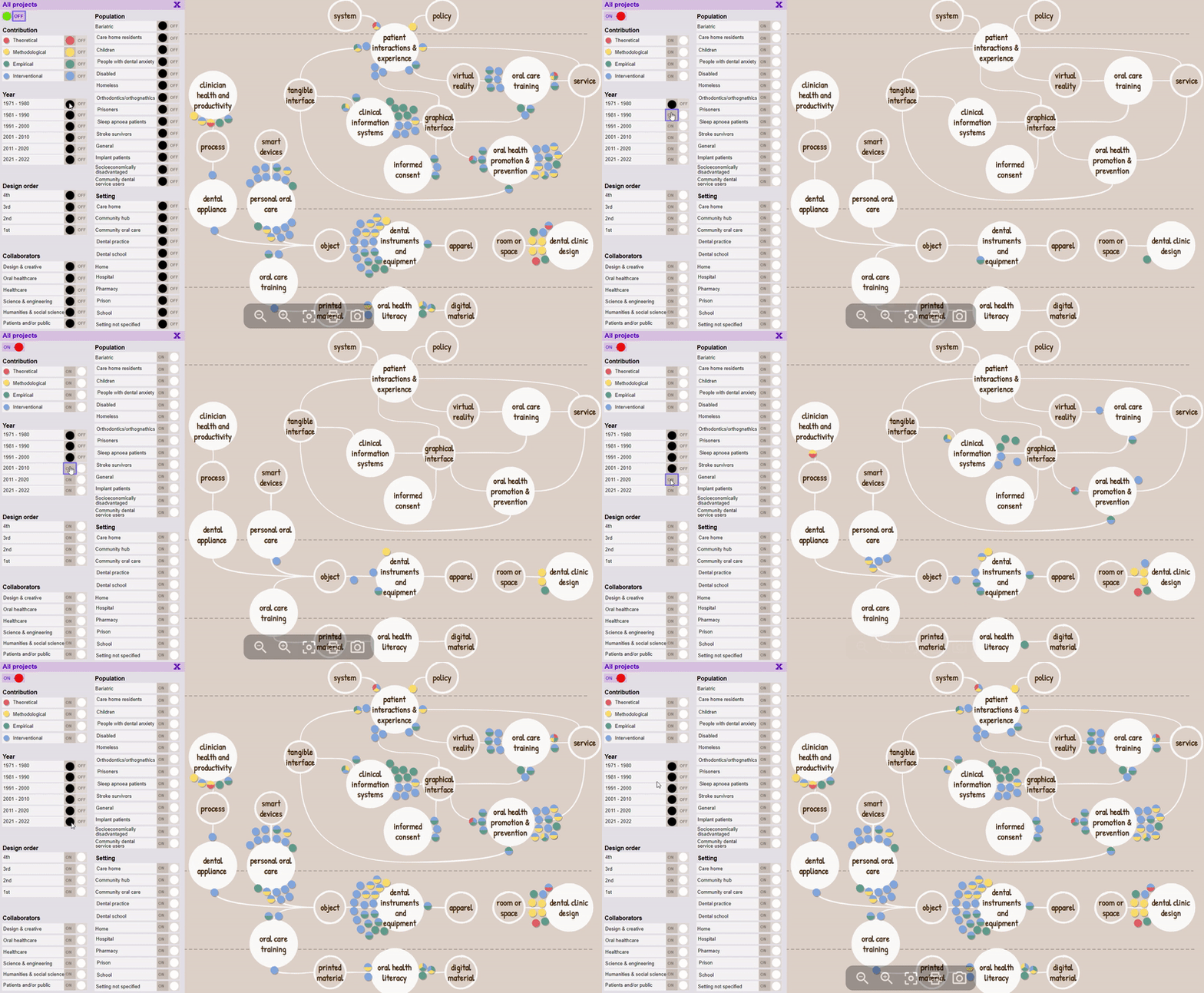
The interactive map above comes from a literature review which forms a crucial foundation for our research in design and oral health. The review aimed to collate and analyse evidence of design application and evolution in oral health, in order understand the current landscape and identify future opportunities.
A design-led approach to evidence mapping
Conducting literature reviews in design can be challenging for numerous reasons. Design processes are generative and responsive, which can make them incompatible with standardised scientific methods and documentation practices. The term “design” is so ubiquitous in scientific literature that it is ineffective for distinguishing design practice and research. Additionally, ill-defined and misused design terminology, along with limited documentation and dissemination of design practice, further complicates the identification, screening and synthesis of evidence.
We are interested in reflecting on, and responding to, issues of quality in design literature reviews, as well as exploring the value that creative approaches can bring to evidence mapping.
Our design-led approach to evidence mapping is based on the following principles:
- Rigorous and robust processes for evidence identification, analysis and synthesis.
- Leveraging visualisations and creative synthesis.
- Encouraging interaction and collaborative exploration of the evidence base.
Systematic mapping study and interactive evidence map
You can read about our review of design in oral health here:
Application and evolution of design in oral health: A systematic mapping study with an interactive evidence map (Community Dentistry and Oral Epidemiology, 2023)
We adopted a systematic mapping methodology for robust and comprehensive identification of evidence of design in oral health. We identified 119 design projects in oral health between 1977 and 2022, which were then classified across various categories. We then explored patterns and relationships between the projects through a series of visual maps. This led to development of the interactive evidence map, which allows users to filter projects on and off and explore the evidence according to different categories. We encourage you to visit the map and explore it for yourself.
Get involved
Going forwards, we believe the interactive evidence map could be used as a living open-access resource, and could offer three potential purposes as an:
- Documentation tool: to capture and map chronological evolution of the field.
- Analytical tool: to facilitate in-depth exploration and multivariate analysis of evidence of design in health, enabling the identification of trends across different categories/levels/contexts.
- Strategic generative tool: to inform new interdisciplinary research streams and collaborations through the identification of critical gaps, strategic opportunities and emerging themes at the intersection of the two fields and beyond.
With this in mind, we are currently thinking about how we might improve and evolve the map and would love to hear your thoughts – you can get involved in the following ways:
 We are currently planning online workshops which will invite people to explore, discuss and improve the interactive evidence map. If you’re interested in finding out more or getting involved in these, please get in touch with Isobel Leason by emailing: isobel.leason@liverpool.ac.uk.
Let us know what you think in the comment section below;
- What do you think about the interactive evidence map?
- Is it missing something?
- How might it be made more useful (and for who)?
 The Inclusionaries Lab