How to change the future
The best way to predict the future is to create it.
Now we have a broad overview of some technologies, we understand how to design well, and we have a map of the current system of Marie Curie Liverpool. Now we know what is, we can ask the question, “What will be?” using our map we can identify System Leverage Points (below) where a small change in one part of our system can produce big changes across the system, like a lever.
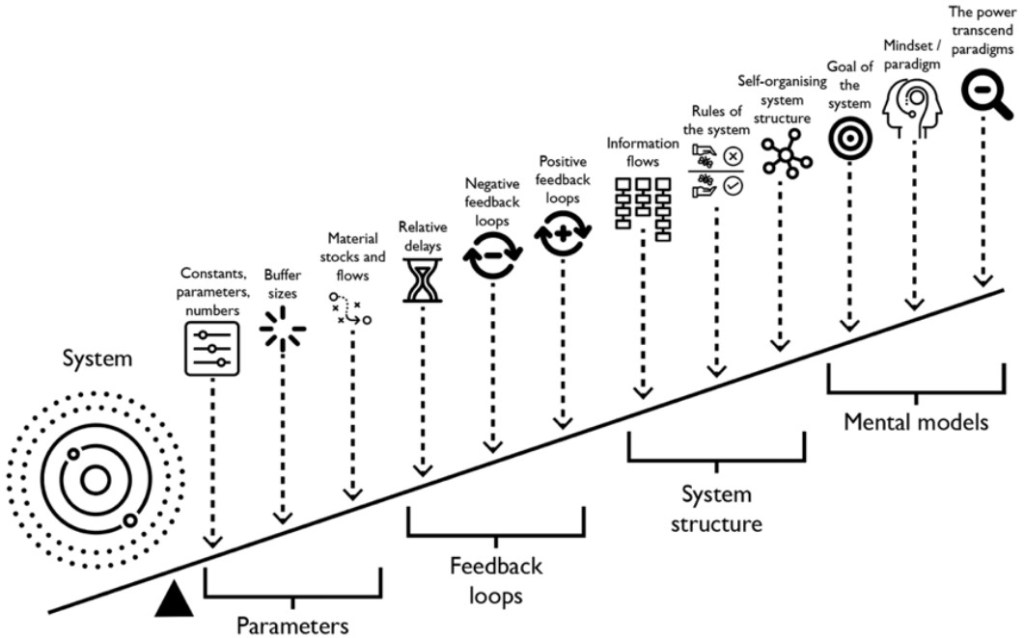
These leverage points can impact change on a large or small scale with ‘Parameters’ at the small end. You’ll be able to spot these in your daily lives, you recycling as an individual isn’t going to solve the entire environmental crisis but it helps.
Mental models at the large end.
In Marie Curie you may have seen the “North Star”, which is the ‘Goal of the system’;
Everyone will be affected by dying, death and bereavement and deserves
the best possible experience, reflecting what’s most important to them.
Marie Curie will lead in end of life experience to make this happen. – MC North Star
as you can imagine, change that and you’ll have to change a lot of the system!
An example of a ‘Mindset’ change would be Nicolaus Copernicus thinking the Earth was not the centre of our solar system, which eventually gave us a greater understanding of our place in the universe.

Clues about our future exists today, the diagram to the above shows those clues as the 3rd Horizon, an example of this would be like imagining the Concord when the Wright brothers took their first flight 66 years prior. Now we know fossil fueled planes can have a negative impact on the environment, how will planes look in another 66 years with that in mind?
It might seem fanciful to imagine what the future could look like decades into the future with the rapidly advancing technologies of today but businesses and governments must do it to reach their goals. Not every company or government will have the same goal, not all of their goals will be to the benefit of everyone, but it will impact every one of us.
We argue that we should imagine the future we want, together.
A way to imagine the future
I’ve seen this one before
In sci-fi films and TV, these imaginary objects are called ‘diegetic prototypes’ they serve as pivotal plot devices, inviting us to ask philosophical questions of the narrative. For example, in works such as Blade Runner, the replicants encourges us to question what it means to be human.

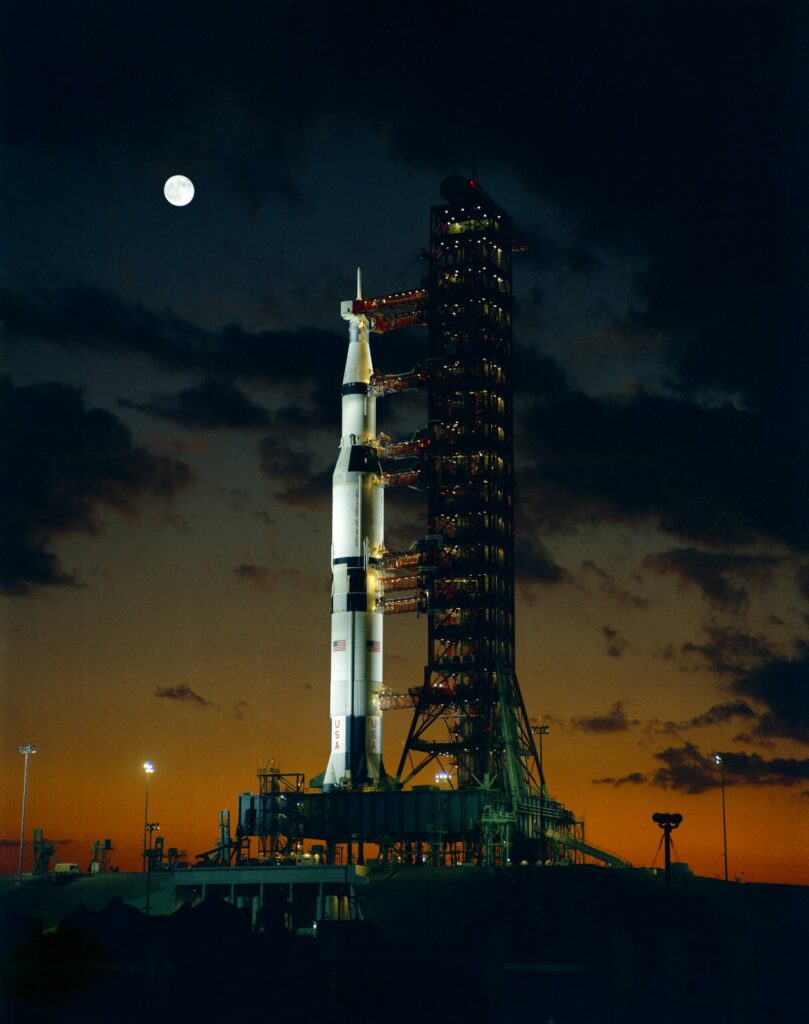
These diegetic prototypes are able to influence the public, policymakers and scientists. They catalyse technological progress and secure funding for ambitious projects, like landing on the moon (True story, Destination Moon (1959), see right, helped scientists and engineers promote the idea of space travel to the public). Rooted in contemporary technology, these prototypes advocate for desirable futures, aiming to transform possibility into reality.
Can you think of a diegetic prototype from a film you’ve seen?
Design Fiction
Through designed objects, we can easily immerse ourselves into the futures we wish to envision. Consider it a form of reverse archaeology. Instead of unearthing fragments from the past to construct narratives, we craft narratives represented through objects
Design Fictions are often examining the role and potential impact of new technologies on everyday life. It helps initiate dialogue between experts and users of new technologies that’s not restrained by the need to sell the product.

Here are some examples of design fiction that should give you a clearer picture of what we’re going to be doing in the activities.
Activities
This is where we create our visions of the future. This is messy fun creative work with a lot of conversations starting with “what if…”, there are no wrong answers, and there are no silly answers. What will happen is that the more content we create here, the more we’ll start to notice themes emerging. Once we have a few we’ll develop them into objects with stories and that’s what we will make for the final exhbition.
This is how things are looking so far
However, we have to be official with this so if you haven’t filled out a participant consent form for our online workshops yet please do so now and email it to me at a.tibbles@liverpool.ac.uk before continuing. If you’ve done it already, carry on!
Once that is done you can either come along to the research hub and start creating stories or head along to Miro where we have an online community board going, Miro is very much like a big sheet with post-it notes so hopefully it should be intuitive, but if not don’t hesitate to contact me.
And Finally!
Congratulations you have reached the end of the designer in residence programme!
I hope you’ve enjoyed it and learned some new and exciting things! We’d love your feedback on how we did and so we have this Post Actitivty Questionnaire (you may remember the pre-activity one, very similar), which is really valuable to the study and if we get to try this out in another Marie Curie site!
 The Inclusionaries Lab