In our Designer-in-Residence programme, we use a systems approach to find out where we can make a big impact in the hospice system by changing a few points of it. Using design methods we imagine what the future of that system may look like and its relationship to technology.
We have made a set of materials you can find below to help you imagine those futures.
If you’re not feeling confident enough to give it a try or would just like a bit of in-person guidance you can ask me (Andrew) to help out and we can work through them together or if you want to do it as a group we can make an activity of it! (You can email me at: a.tibbles@liverpool.ac.uk – I will accept payments in the form of flat whites and lemon-based baked goods).
There will be a space in the Research Hub where everyone’s input will be put together so we can make a big picture of the hospice of the future.
This will all be leading to an exhibition of desirable futures in the coming months (with an opening night, of course), everyone who takes part can have their name up there, if you want, as contributing towards it.
Before going any further please please please fill out our CONSENT FORMS and quick PRE-ACTIVITIES QUESTIONNAIRE and so this is all above board and officially part of the study, theres another questionnaire at the end and it lets us know how well we’ve made this series and important to the over all study (and me), it wont take more that 5 minutes.
Ok, now you’ve done that you can keep going. Thank you!

Want to learn more about the good and bad of technology in the context of hospice care? Follow this link.
Technology
We are not going to be escaping technology being a part of our lives and death any time soon, except in a post-apocalyptic scenario, in that case, we’ll have other priorities like water, food, shelter and finding out what that strange noise coming from the sea is.
Technology can help us and is essential to a modern hospice service, but we know from the pandemic it is not the solution to everything and sometimes it creates its own set of problems.
We can imagine future applications of emerging technologies and question what could they help us with and what are the potential problems of this technology in the future.
How does and will technology affect the hospice experience?

Want to learn more about what design has to offer in a place where designers aren’t usually found?
Follow this link
Design
Using a design approach combined with systems we aim to balance rigorous data with the human stories behind that data. We believe that will have the biggest impact on influencing hearts and minds.
Design is everywhere, and can be done by anyone. Thoughtful design will be useful, intuitive and a pleasure to use. It’s said that good design is invisible, but bad design you can notice everywhere.
Humans are essential to the design process and the more input we get the more rounded the outcome will be. Everyone’s an expert in the experiences they have lived through, and how those experiences made you feel, good or bad. All of it’s important.
What could we design for the future of hospice care that would make that experience better?

Want to learn how to tell a non-linear story of how this affects that and that affects the other? Follow this link
(we’re aiming to make a big one for the whole hospice service!)
Systems
Using a systems approach helps us to understand and change something incredibly complex with some idea about how that change can come about.
Through Causal Loop Diagramming we can begin to see that complexity and find large causes and effects of the system leading to discovering Leverage Points of the system. We can set long-term visions with stakeholders that act as goals for our system and find ways that we can transition towards them iteratively, track the change and adjust the course if we need to.
It does not provide a permanent perfect solution for everyone but aims for something better than today.
What affects the hospice experience quality today?
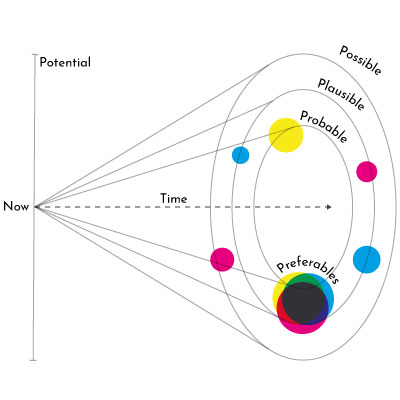
Want to imagine new desirable futures of hospice care? There are no wrong answers so follow this link
Futures
During the pandemic, we had to be reactive to a complex situation and long-standing routines of a system changed very rapidly to keep up with demand and the daily changes in restrictions to keep going.
Now we have a chance to be proactive and assess what is valuable and desirable in our system and how we tackle the upcoming complex situation of an ageing population and shrinking workforce with the aid of design and technology.
What do we want to keep from the pandemic that worked, what didn’t work and want to get rid of and what do we see as potentially working and want to develop further to find out?
What are the values we want to take into the future with us?
Participation Information & Consent Forms
We have to be official with this so if you haven’t filled out a participant consent forms for our questionnaire and online workshops yet please do so now and email it to me at a.tibbles@liverpool.ac.uk before continuing.
If you’re wondering “why two?”, it is because there could be a considerable time between you doing the questionnaire and the workshop activities but when they are done you don’t need to do them again (also the ethics committee told me it needs to be done this way and I’m not going to argue with them).
 The Inclusionaries Lab